Johanna Ortiz Florence Open Back Crepe De Chine Blouse
T he old blouses of the stiff collar and cuffs would hardly recognise their descendants of to-day with the wide necks, the long, straight lines, the entire absence of stiffness, which are protests against any tendency to cabin and confine.
But even the straight blouse, so easy and so flowing in line, has been under a cloud. It has passed over into the dress to a great extent and its independent existence has been threatened by its very easiness.
Now again the blouse as a unit is making one more bid for favour. Shall it be long, very long, so long as to reach nearly to the bottom of the dress? Shall it continue to be part of the dress or shall it only compromise in that it forms a suitable contrast?
Both kinds of blouse or jumper or casaquin, as they may be called, are striving for predominance – a process which, in reality, is a mortal combat between the dressmakers and the blouse-makers as separate organisations.
There is undoubtedly very much to be said for the separate blouse, in spite of the disrepute into which such conceptions as the "dressy" blouse formerly led it. The time is past when, ostrich-like, people put on a different blouse and thought that the rest didn't matter. The other extreme is the dress which only recalls the blouse in that the upper part is made of a different material from the lower part.
Peasant blouse
There is, however, a middle road, based on the fact that the blouse is actually a traditional garment among the human race, as traditional as a head-covering which eventually becomes a hat.
Peasant blouses in various parts of the world testify to the permanent factor in blouses, and actually the peasant blouse has held its own among all the varying fortunes of the fashionable blouse.
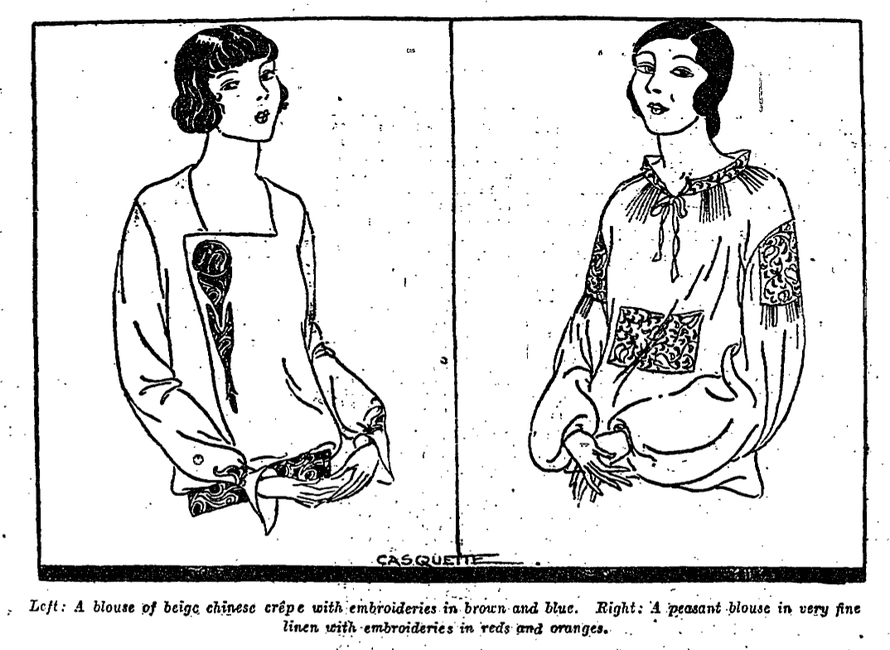
Peasant blouses have been adapted to modem requirements, at least as far as shape. Slav embroidery can be used on any sort of neck and the blouse can flow over the hips, or, as in the present ease, be gathered into the embroidered belt, which encompasses the hips more or less closely. The characteristics which are retained are the long, flowing sleeves, the fullness of which falls well over the hand, and the crepe material which allows for a large amount of close gathering.
The embroidery is also generally placed in a characteristic position, such, for instance, as round the middle portion of the sleeves and in a sort of ephod, back and front.
This fashion for peasant blouses, by the way, is providing a good deal of work for indigent Russians in Paris, who are called upon both to design and execute the embroidery. The contrasting blouse harks back frankly to a previous fashion and is often in white, either of silk or cotton. When it is of silk, crepe-de-Chine and very thick Chinese silk may be used; in cotton and linen, dimity, organdie, lawn, and other very white or very transparent materials are used.
This is an edited extract.
Johanna Ortiz Florence Open Back Crepe De Chine Blouse
Source: https://www.theguardian.com/fashion/2021/dec/17/the-battle-of-the-blouses-fashion-archive-1923

Post a Comment for "Johanna Ortiz Florence Open Back Crepe De Chine Blouse"