The Only True Wisdom Consists in Knowing That You Know Nothing
Socrates on Wisdom
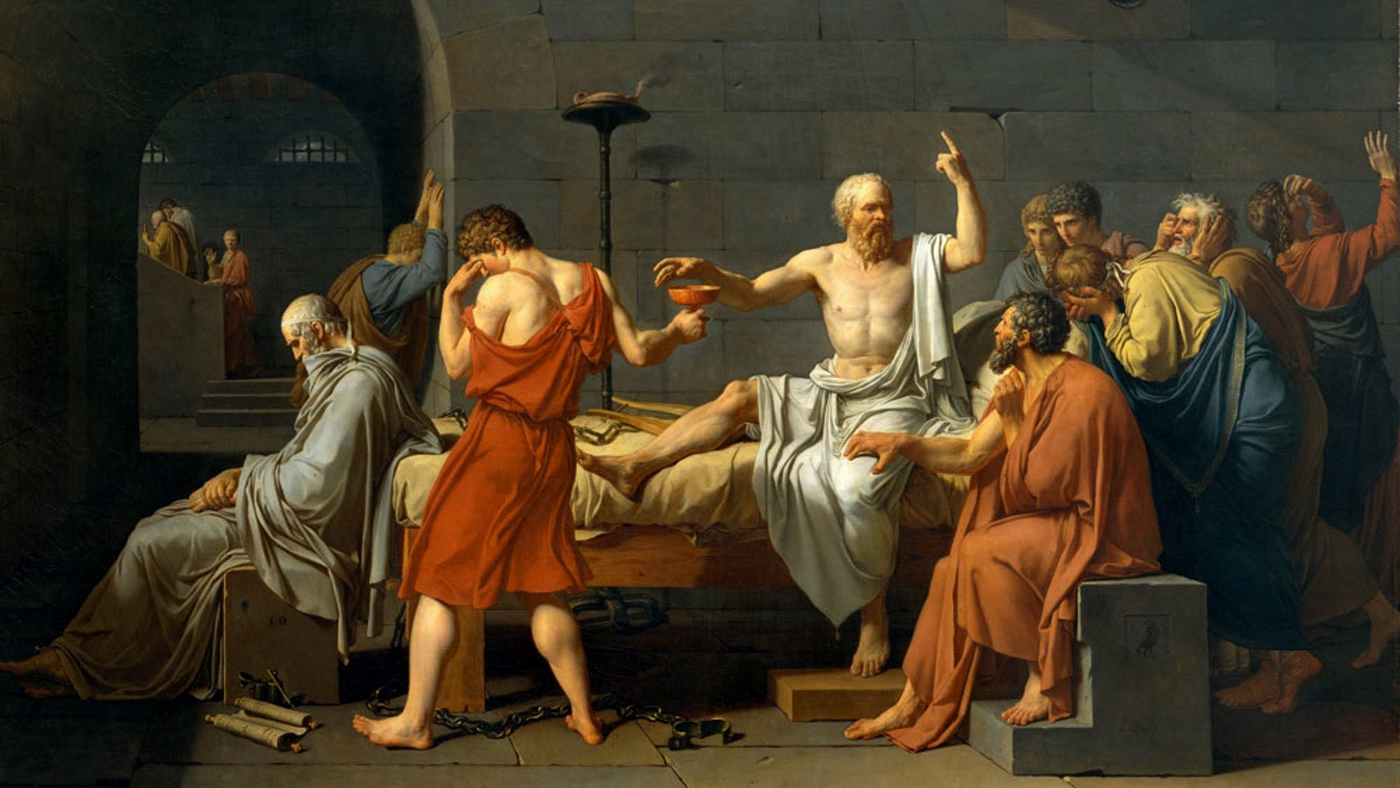
Socrates was by far i of the most important philosophers. Still, he wrote no works of his own; therefore we come up to know nigh Socrates' life and teachings through his educatee and friend Plato (427 BCE — 347 BCE). The Apology, which was written past Plato, is undeniably one of the most important writings on Socrates' speech that he gave at his trial. Socrates was accused of impiety and corrupting the youth. In Plato's Apology, Socrates repeatedly refers to a unmarried God, and he refused to honor the Greek gods. He was defending himself and his conception of philosophy, nevertheless, Socrates was found guilty and he was sentenced to decease.
Nosotros come up to know of the phrase that "an unexamined life is not worth living" towards the stop of his trial. Socrates believed that the purpose of life was to abound spiritually, and philosophically; he argued that is was of import to question and "examine" your values and behavior in club to determine if they were the correct ones. Socrates' way of examining people was past using his method of elenchus, in other words, the Socratic method. He believed that this method made people more than aware of their ignorance and therefore, leads to humility and modesty.
One of Plato's nearly of import works is unquestionably the Apology, which is essentially a record of the speech Socrates gave at his trial. The trial took place in Athens in 399 BC. Socrates was not only defending himself, but was besides defending his conception of philosophy. According to Socrates, virtue is fundamental and philosophy is an examination of ourselves towards virtue. He was accused of two things, which were corrupting the youth of Athens, and introducing a new God.
Early in Socrates' defense speech, he explained that his friend Chaerephon went to the oracle of Delphi and asked whether there was anyone wiser than Socrates. The oracle told Chaerephon that no ane is wiser than Socrates. Socrates was baffled past this news as he establish it very hard to believe that he was the wisest man. Socrates was enlightened of his own ignorance; he did non think he was wise. Thus, he decided to attempt to refute the oracle by finding someone who was wiser than himself. He spoke to people with dissimilar profession's, such every bit politicians, poets, and craftsmen; however, he found that they simply possessed "human being wisdom". For instance, the artisans were only wise in their art, but they lacked wisdom in what Socrates referred to every bit "college things" or "man excellence." Socrates establish that:
"I am wiser than this man, for neither of u.s.a. appears to know annihilation great and skilful; just he fancies he knows something although he knows zilch; whereas I, as I do not know anything, so I practice not fancy I do."
This therefore shows that because they all claimed they were wise this fabricated them not so wise, whereas Socrates never claimed to be wise every bit he was conscious of his own ignorance about higher matters; thus he had a type of wisdom. Socrates therefore saw it as his responsibility to examine himself and others: that is to live the life of a philosopher.
Socrates provides us with a vivid method, called the Socratic method, or the method of elenchus i.e. "examination." The Socratic method was not necessarily used to determine what is not truthful, but rather to determine what cannot be truthful. Thus, this method was used throughout the Socratic dialogues. For Socrates, this method of determining what is and is not true occurs always in the context of discourse and dialogue with others. The Socratic method ever begins with Socrates asking his interlocutor "what is… X?" For case what is piety, or what is justice? This question is fundamentally afterwards the essence of something; what is essential about these moral qualities such equally backbone. Socrates ever proclaims ignorance; he always says he does not know anything. The interlocutor then offers an answer, however, the answer given is not what Socrates is looking for, every bit Socrates wants to know the essence of X. The interlocutor and then provides a definition, notwithstanding, Socrates discovers a contradiction with the answer given and shows that the definition cannot be correct. This procedure carries on and Socrates continues to find inconsistencies by showing that the definitions cannot be truthful.
An case of this is in Plato's Phaedo where Socrates asks Simmias "Do we allow that there is such a thing every bit equality?" Each time an answer is given Socrates finds an inconsistency with Simmias' answer. This continues until Simmias runs out of definitions of equality, so the give-and-take ends. Thus, "Socrates here not only reminds Simmias of his ignorance just makes him painfully aware of his ignorance." This is of import because Socrates wanted people to "examine" their lives and become aware of their ain ignorance rather than thinking that they know things when really they know nothing.
Although the Socratic method does not uncover what Socrates is actually looking for, it instead results in the interlocutors and Socrates himself being left in a country of aporia, in other words, a state of perplexity. Since the Socratic method often leaves people in a country of aporia (perplexity) it could exist argued that there is no usefulness to be gained from it. Nonetheless, Socrates talks about the benefit of perplexity and claims that it brings people closer to the truth:
"Sometimes ignorance is better than knowledge; he argues that the only truly valuable noesis is the knowledge of the good, an authoritative knowledge that will correctly advise usa when to use other goods and skills in our possession."
Therefore, according to Socrates, the elenchus method is essential as information technology is a way of testing your lack of cognition by examining your ideas and beliefs. So even though it does atomic number 82 to perplexity, information technology makes you more than witting of your own ignorance and consequently it makes you a better person.
In determination, Socrates believed that philosophy was an improvement of the soul every bit it reveals our ignorance; therefore information technology is important to alive an "examined life." He believed that you will nearly likely lead a miserable life if you practice not question your behavior and ideas. Socrates always claimed that he did not know anything; this resonates the essence of what Socrates is about. Wisdom is a sort of recognition of your own ignorance, thus Socrates knows that he is not wise; therefore he has a type of wisdom. At the terminate of his trial Socrates argued:
"If I say that information technology is the greatest good for a man to discuss virtue every twenty-four hours and those other things about which you lot hear me conversing and testing myself and others, for the unexamined life is not worth living for men, you will believe me fifty-fifty less."
Socrates concludes that the life worth living is an examined life. "Socrates himself said that he was a horsefly put by the gods 'on the flanks' of a 'sluggish' Athens in an endeavor to 'wake it upward'". In other words Socrates believed it was his duty to make people aware of their ignorance. He believed that if you do not examine your ideas and behavior and test them to make up one's mind whether or non they are contradictory, and you lot live your entire life based upon those ideas; you volition, co-ordinate to Socrates, take lived a deceitful life; a life of false belief. This is the great danger that he wanted to tackle.
For Socrates, noesis is the most valuable affair in life, however, he believed that it is better to seek knowledge and be conscious of your own ignorance than to claim noesis that you lot really practice not have.
Follow Thoughts and Ideas on Facebook: facebook.com/thoughtsandideas1
norrisbeglinver1987.blogspot.com
Source: https://medium.com/indian-thoughts/the-only-true-wisdom-is-in-knowing-you-know-nothing-5789c8994cc6

Post a Comment for "The Only True Wisdom Consists in Knowing That You Know Nothing"